Physical AI: How AI Is Moving From Screens Into the Real World
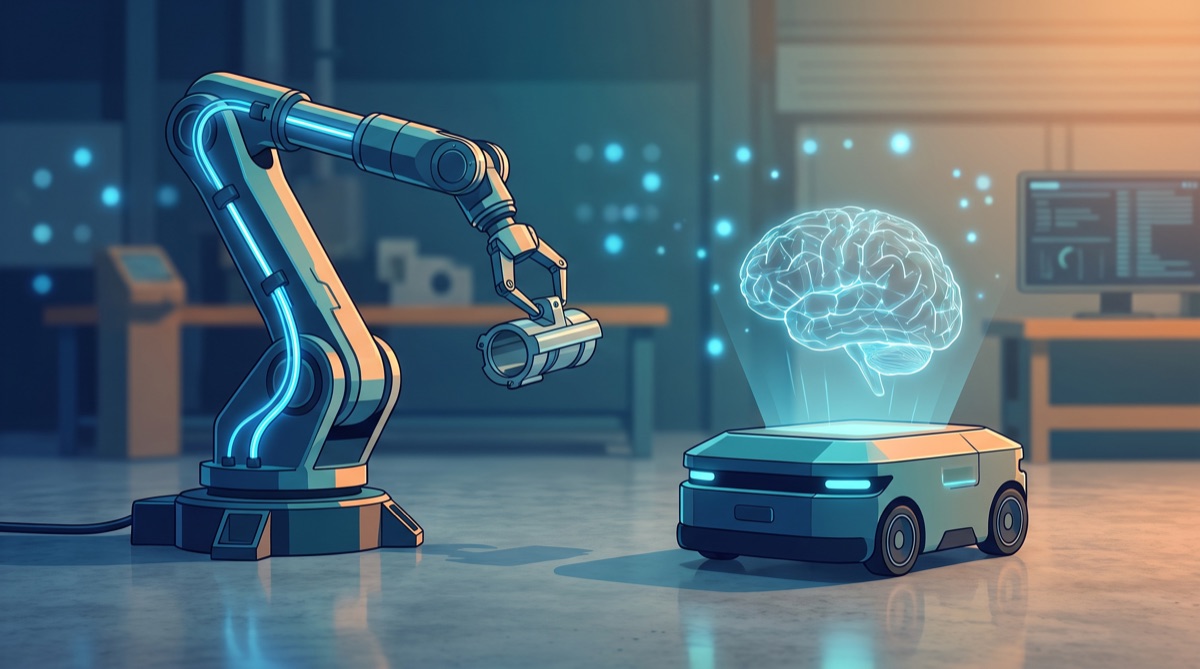
For the last few years, “AI” has mostly meant something on a screen: a chatbot that writes, a tool that generates images, an assistant that answers questions. But a significant shift is underway. AI is beginning to step out of the chat box and into the physical world — controlling robots, vehicles and machines that sense their surroundings and take real actions. This is physical AI, and 2026 is shaping up to be the year it moved from research demo toward reality. Here’s what it means and why it matters.
What “physical AI” actually means
Physical AI — sometimes called embodied AI — describes AI systems that don’t just process information but perceive and act in the real world. Instead of turning a prompt into text, a physical-AI system turns sensor input (cameras, lidar, touch) into physical action: a robot arm that picks the right object, a vehicle that navigates a street, a machine that adjusts itself to changing conditions.
The distinction matters because the real world is far less forgiving than a text box. A chatbot that makes a mistake produces a wrong sentence. A physical system that makes a mistake can drop an object, block traffic, or worse. That raises the bar enormously — which is exactly why it’s taken longer than software-only AI.
Why 2026 is a turning point
Two things converged. First, the core capabilities that made modern AI impressive — multimodal understanding (seeing as well as reading), stronger reasoning, and agentic planning (the think-act-observe loop) — are precisely what a machine needs to operate in the world. Second, the major AI labs have started explicitly targeting physical AI. Google’s 2026 direction, for example, pointed beyond chatbots toward agents, scientific tools and AI that can act in real systems (DigitalApplied).
In other words, the “brain” got good enough that connecting it to a “body” finally became worthwhile. The shift from generation to action that we’ve seen in software agents is now extending to physical machines.
Where physical AI is genuinely useful
This isn’t science fiction — it’s showing up in concrete places:
- Warehousing and logistics. Robots that can perceive cluttered shelves and handle varied objects — long a hard problem — are getting dramatically better at picking, sorting and packing.
- Manufacturing. Machines that adapt to variation on the line rather than following rigid pre-programmed motions.
- Autonomous vehicles. Beyond driving itself, a notable 2026 theme is explainability — work from groups like Motional and MIT on getting self-driving systems to explain their decisions, which matters for trust and safety (DigitalApplied).
- Inspection and agriculture. Drones and ground robots that perceive crops, infrastructure or equipment and act on what they see.
The pattern: physical AI shines where the environment is variable and hard to pre-program, and where perception plus judgment beats fixed rules.
The hard parts (and honest limits)
Physical AI is genuinely difficult, and it’s worth being clear-eyed:
- Safety is paramount. Actions have real consequences, so these systems need guardrails, testing and human oversight far stricter than a chatbot’s.
- The real world is messy. Lighting, clutter, unexpected obstacles and edge cases break systems that looked perfect in a demo.
- Reliability, not novelty, is the bottleneck. A robot that works 95% of the time can be useless if the other 5% is costly — the last few percent of reliability is the hardest and most expensive.
- Explainability matters more. When a machine acts physically, “why did it do that?” stops being academic. Expect explainability to be a defining theme.
What it means for the rest of us
You don’t need to build a robot to feel this shift. Physical AI will show up as more capable devices and services: smarter appliances, more reliable delivery and logistics, better assistive technology, and eventually machines that handle dull or dangerous work. As with software AI, the winners will pair the technology with genuine reliability and a human in the loop — not flashy demos.
The takeaway
Physical AI — intelligence that perceives and acts in the real world — is the natural next step after the chatbot era, and 2026 is when it started getting serious attention from the biggest labs. The same advances that made AI good at thinking are now being pointed at machines that do. The technology is genuinely hard, safety and reliability are the real bottlenecks, and the hype will outrun reality in places — but the direction is clear. AI is leaving the screen, and the real world is the next frontier.
Sources: reporting on 2026 AI directions including DigitalApplied. Physical-AI capabilities are advancing quickly; treat specific product claims with healthy skepticism.
Frequently Asked Questions
What is physical AI?
Physical AI (also called embodied AI) refers to AI systems that perceive and act in the real, physical world — controlling robots, vehicles, drones and machines — rather than only generating text or images on a screen. It combines perception, reasoning and physical control.
How is physical AI different from a chatbot?
A chatbot processes and produces information. Physical AI must also sense its surroundings through cameras and sensors, understand a changing 3D environment, and take safe physical actions with real consequences — a much harder problem because mistakes affect the real world.
Why is physical AI a big deal in 2026?
The same advances that made chatbots capable — better reasoning, multimodal understanding and agentic planning — are now being applied to machines that act. In 2026, major AI labs began explicitly targeting 'physical AI,' signalling a shift from software-only intelligence toward systems that operate in the real world.