Python has become the backbone of the generative AI revolution, powering everything from ChatGPT to DALL-E. This guide is for developers, data scientists, and tech enthusiasts who want to understand why Python dominates the AI landscape and how it’s shaping the future of large language models.
Python’s simple syntax and massive ecosystem make it the go-to language for AI researchers and engineers building the next generation of intelligent systems. While other programming languages exist, Python’s combination of flexibility and powerful libraries has made it the standard for machine learning development.
We’ll explore how Python’s core libraries like TensorFlow, PyTorch, and Hugging Face Transformers are driving LLM innovation. You’ll also discover the performance advantages Python offers when training massive neural networks, plus real-world examples of Python-powered AI applications that are changing industries today.
Python’s Foundational Role in AI Development Infrastructure

Simplified syntax accelerates machine learning model development
Python’s clean, readable syntax makes it perfect for building complex AI systems without getting bogged down in complicated code. When you’re working on intricate algorithms for language models, the last thing you want is wrestling with convoluted syntax that obscures your logic. Python’s English-like structure lets developers express complex mathematical concepts and data transformations in just a few lines of code.
Consider how you can implement a basic neural network layer in Python with minimal code compared to lower-level languages. This simplicity doesn’t come at the cost of functionality – it actually speeds up the entire development cycle. Researchers can quickly prototype new architectures, test different approaches, and iterate on their models without spending hours debugging syntax errors or memory management issues.
The language’s dynamic typing system adds another layer of flexibility. You can experiment with different data structures and model configurations on the fly, making Python ideal for the experimental nature of AI research where you’re constantly tweaking parameters and trying new approaches.
Extensive library ecosystem reduces development time and complexity
Python’s AI ecosystem is massive, giving developers access to pre-built tools that would take months or years to develop from scratch. Libraries like NumPy handle mathematical operations with blazing speed, while pandas makes data manipulation effortless. When you need to process millions of text samples for training a language model, these libraries handle the heavy lifting.
Machine learning frameworks built on Python have become the industry standard. TensorFlow and PyTorch provide high-level abstractions for building neural networks, complete with automatic differentiation and GPU acceleration. Instead of implementing backpropagation algorithms manually, you can focus on designing better model architectures and training strategies.
| Library Category | Key Libraries | Primary Function |
|---|---|---|
| Deep Learning | TensorFlow, PyTorch, Keras | Neural network construction and training |
| Data Processing | NumPy, Pandas, Dask | Numerical computing and data manipulation |
| Natural Language | spaCy, NLTK, Transformers | Text processing and NLP tasks |
| Visualization | Matplotlib, Plotly, Seaborn | Data analysis and model interpretation |
Specialized libraries for AI tasks continue emerging regularly. The Hugging Face Transformers library, for example, provides access to thousands of pre-trained language models with just a few lines of code. This democratizes access to cutting-edge AI capabilities that would otherwise require massive computational resources and expertise.
Cross-platform compatibility enables seamless deployment across systems
Python runs consistently across different operating systems and hardware configurations, making it perfect for AI projects that need to work everywhere from laptops to massive cloud clusters. This compatibility becomes critical when you’re training models on Linux servers but need to deploy them on Windows production systems or edge devices.
Cloud platforms have embraced Python as their primary language for AI services. Whether you’re using AWS, Google Cloud, or Azure, Python-based AI models integrate seamlessly with their infrastructure. You can develop locally on your machine, train on powerful cloud instances, and deploy to production environments without worrying about compatibility issues.
Container technologies like Docker work exceptionally well with Python, allowing you to package your entire AI application with all dependencies into portable units. This solves the notorious “it works on my machine” problem that often plagues complex AI deployments.
Strong community support provides continuous innovation and problem-solving
Python’s AI community is incredibly active and collaborative, creating a constant stream of improvements, bug fixes, and new capabilities. When you run into issues implementing a complex language model architecture, chances are someone has faced the same challenge and shared their solution on Stack Overflow, GitHub, or research forums.
Open-source contributions drive rapid innovation in the Python AI ecosystem. Major tech companies regularly release their internal tools as open-source Python libraries, giving everyone access to enterprise-grade capabilities. Facebook’s PyTorch, Google’s TensorFlow, and OpenAI’s various tools all started as internal projects before becoming community standards.
The community also maintains extensive documentation, tutorials, and educational resources. Whether you’re a beginner learning the basics or an expert implementing cutting-edge research, you’ll find detailed guides and examples. This knowledge sharing accelerates the entire field, allowing new developers to quickly get up to speed and contribute their own innovations.
Research papers increasingly include Python implementations, making it easier to reproduce results and build upon existing work. This creates a virtuous cycle where theoretical advances quickly become practical tools available to the entire community.
Essential Python Libraries Driving LLM Innovation
TensorFlow and PyTorch enable efficient neural network construction
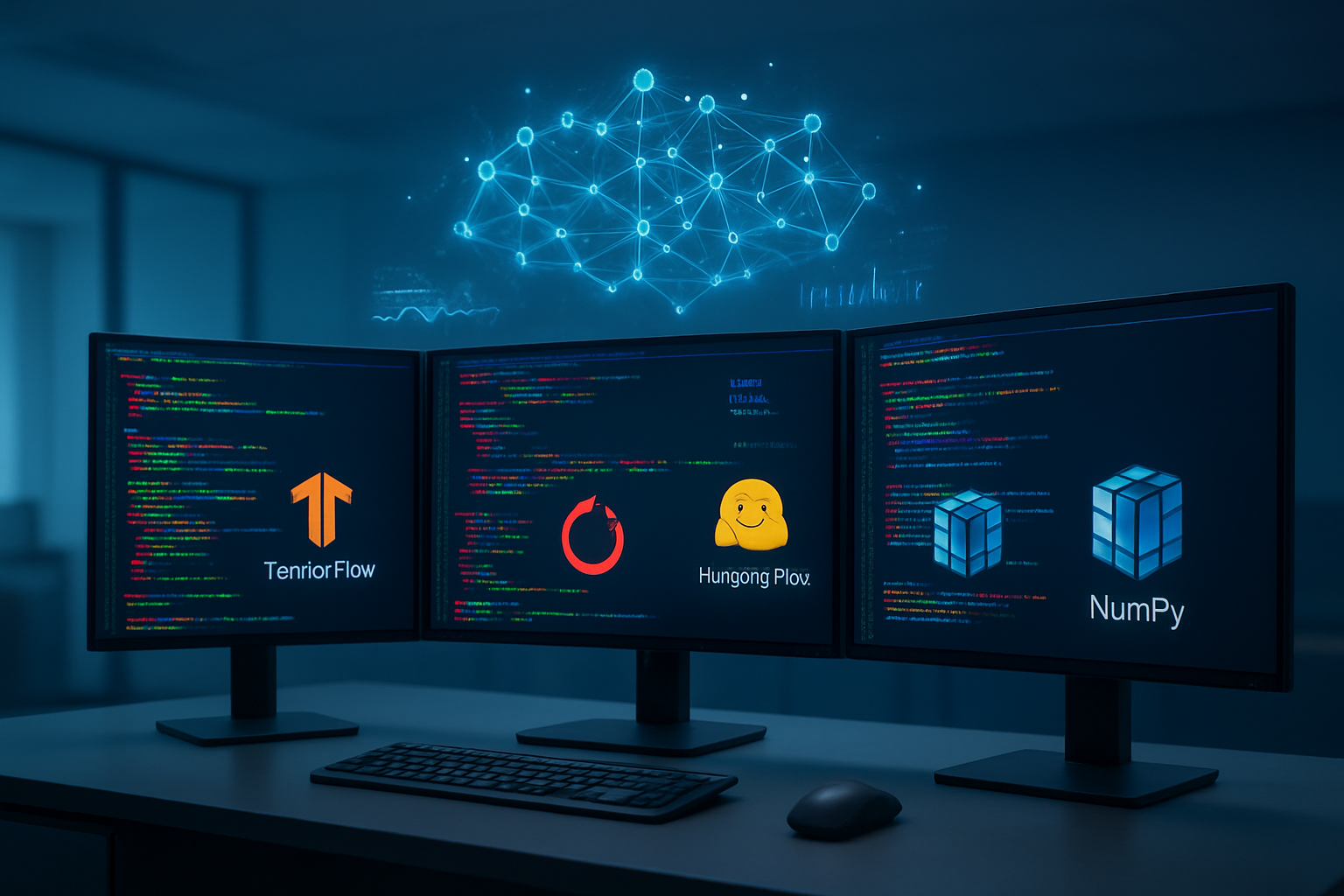
TensorFlow and PyTorch have become the backbone of modern language model development, each offering unique advantages for building complex neural architectures. TensorFlow’s computational graph approach provides exceptional scalability for enterprise-level deployments, while PyTorch’s dynamic graph execution offers researchers the flexibility needed for experimental model designs.
TensorFlow excels in production environments where stability and performance matter most. Its distributed training capabilities allow teams to train massive language models across multiple GPUs and TPUs, significantly reducing training time. The framework’s TensorFlow Serving component makes deploying trained models seamless, handling millions of inference requests efficiently.
PyTorch has captured the hearts of researchers and developers with its intuitive Python-first approach. The framework feels natural to Python developers, making complex operations like attention mechanisms and transformer blocks straightforward to implement. PyTorch’s eager execution mode enables real-time debugging, which proves invaluable when experimenting with novel architectures.
Both frameworks provide specialized tools for language models. TensorFlow’s tf.text module handles tokenization and text preprocessing, while PyTorch’s torchtext simplifies dataset management and vocabulary building. The choice between them often depends on specific project requirements – TensorFlow for production-ready systems, PyTorch for cutting-edge research and rapid prototyping.
Hugging Face Transformers simplify pre-trained model implementation
Hugging Face Transformers has revolutionized how developers interact with pre-trained language models, eliminating months of implementation work with just a few lines of code. This library democratizes access to state-of-the-art models like GPT, BERT, and T5, making advanced AI capabilities available to developers regardless of their deep learning expertise.
The library’s unified API design means switching between different model architectures requires minimal code changes. Whether you’re working with BERT for text classification, GPT for text generation, or T5 for translation tasks, the interface remains consistent and intuitive. This consistency accelerates development cycles and reduces the learning curve for new team members.
Pre-trained model availability through Hugging Face Hub has transformed the AI landscape. Developers can access thousands of models trained on diverse datasets, from general-purpose language understanding to domain-specific applications like medical text analysis or legal document processing. The hub’s collaborative nature encourages knowledge sharing and continuous improvement across the AI community.
Fine-tuning capabilities built into the Transformers library make customization straightforward. The Trainer class handles complex training loops, gradient accumulation, and distributed training setup automatically. This abstraction allows developers to focus on data preparation and model evaluation rather than low-level training mechanics.
NumPy and Pandas optimize data processing and manipulation workflows
NumPy serves as the mathematical foundation underlying all major AI frameworks, providing optimized array operations that make large-scale data processing feasible. Its vectorized operations eliminate the need for explicit loops, dramatically improving performance when handling the massive datasets required for training language models.
The library’s broadcasting capabilities enable elegant mathematical operations across arrays of different shapes, essential for transformer attention mechanisms and embedding computations. NumPy’s memory-efficient data structures ensure optimal RAM usage when processing multi-gigabyte text corpora, preventing memory bottlenecks that could halt training processes.
Pandas transforms raw text data into structured formats suitable for model training. Its powerful DataFrame structures handle complex data manipulations like text cleaning, tokenization, and feature engineering with remarkable efficiency. The library’s built-in functions for handling missing values, duplicate removal, and data type conversions streamline the preprocessing pipeline.
Data loading and batching operations benefit significantly from Pandas’ optimized I/O capabilities. Reading massive CSV files, JSON datasets, or database queries becomes manageable through Pandas’ chunking mechanisms, allowing developers to process datasets larger than available memory. Integration with other libraries in the Python ecosystem creates seamless workflows from raw data ingestion to model-ready formats.
The combination of NumPy and Pandas creates a powerful data preprocessing pipeline that handles everything from basic text cleaning to complex feature engineering, ensuring high-quality inputs for language model training.
Python’s Performance Advantages in Training Large Language Models

Memory Management Capabilities Handle Massive Datasets Efficiently
Python’s memory management system plays a crucial role in handling the enormous datasets required for training large language models. The language’s garbage collection mechanism automatically frees up memory that’s no longer needed, preventing memory leaks that could crash training processes running for days or weeks. Python’s memory allocator uses object pools and reference counting to optimize memory usage patterns common in machine learning workloads.
Modern LLM training often involves datasets with billions of parameters and terabytes of text data. Python handles this through sophisticated memory mapping techniques that allow models to access data without loading everything into RAM at once. Libraries like NumPy and PyTorch leverage Python’s memory management to create efficient data structures that can swap between system memory and storage as needed.
The language also supports memory-efficient data loading through generators and iterators, which process training batches one at a time rather than loading entire datasets. This approach enables training on datasets that are larger than available system memory, making it possible to work with massive corpora on standard hardware configurations.
GPU Acceleration Through CUDA Integration Maximizes Computational Power
Python’s seamless integration with CUDA transforms GPU computing from a complex programming challenge into an accessible tool for AI researchers. Through libraries like CuPy and PyTorch, Python developers can write code that looks nearly identical to standard CPU operations while actually running on thousands of GPU cores simultaneously.
The CUDA integration allows Python to offload tensor operations, matrix multiplications, and neural network forward/backward passes to GPUs, achieving speedups of 10-100x compared to CPU-only implementations. This acceleration is essential for training large language models, where single training runs can require thousands of GPU-hours.
Python’s CUDA support includes automatic memory management between CPU and GPU memory spaces, handling the complex data transfers that would otherwise require extensive low-level programming. The language also supports multi-GPU setups, allowing models to be distributed across multiple graphics cards within a single machine for even greater computational power.
Distributed Computing Support Enables Multi-Machine Training Clusters
Python’s distributed computing capabilities allow LLM training to scale across multiple machines, creating powerful computing clusters from standard servers. The language supports various distributed training paradigms, including data parallelism, model parallelism, and pipeline parallelism, each suited for different aspects of large-scale model training.
Through frameworks like PyTorch Distributed and Horovod, Python can coordinate training across dozens or hundreds of machines, synchronizing gradients and model updates across the entire cluster. This distributed approach makes it possible to train models with hundreds of billions of parameters that wouldn’t fit on any single machine.
Python handles the complex networking and communication protocols required for distributed training, including fault tolerance mechanisms that allow training to continue even when individual machines fail. The language’s support for message passing interfaces (MPI) and TCP/IP networking enables efficient data sharing between cluster nodes.
Automatic Differentiation Streamlines Gradient Calculation Processes
Python’s automatic differentiation capabilities eliminate one of the most complex aspects of neural network training: calculating gradients for backpropagation. Instead of manually deriving and coding gradient calculations, Python frameworks automatically compute derivatives for any combination of operations, no matter how complex the model architecture.
This automatic differentiation works by building computational graphs that track every operation performed during the forward pass, then efficiently computing gradients during the backward pass. Python’s dynamic nature allows these graphs to be constructed and modified at runtime, supporting flexible model architectures that can change based on input data.
The gradient calculation process in Python is highly optimized, using techniques like gradient checkpointing to trade computation time for memory usage, and gradient accumulation to handle batch sizes larger than available memory. These optimizations are crucial for training large language models efficiently.
Scalable Architecture Accommodates Growing Model Complexity
Python’s flexible architecture adapts naturally to the ever-increasing complexity of modern language models. The language supports modular design patterns that allow researchers to experiment with new architectures, attention mechanisms, and training techniques without rewriting entire codebases.
The ecosystem provides abstractions that scale from simple neural networks to complex transformer architectures with billions of parameters. Python’s object-oriented programming model enables clean separation between model components, making it easy to swap out different attention heads, embedding layers, or activation functions during research and development.
Python’s scalability extends to hyperparameter optimization, where frameworks can automatically search through thousands of possible configurations across distributed computing resources. This capability is essential for finding optimal settings for increasingly complex models that have hundreds of hyperparameters to tune.
Real-World Applications Showcasing Python’s AI Capabilities

ChatGPT and GPT models demonstrate conversational AI excellence
OpenAI’s ChatGPT stands as perhaps the most visible example of Python’s transformative impact on generative AI. Built using Python’s extensive machine learning ecosystem, ChatGPT leverages frameworks like PyTorch and transformers libraries to process billions of parameters across its neural networks. The model’s training pipeline relies heavily on Python’s data processing capabilities, using libraries such as NumPy for numerical computations and pandas for handling massive datasets of conversational text.
The GPT family of models showcases Python’s ability to handle complex natural language understanding tasks. From GPT-3’s initial breakthrough to GPT-4’s multimodal capabilities, these systems demonstrate how Python’s flexibility enables rapid experimentation and deployment. The inference engines that power these models in production environments utilize Python’s asynchronous programming features, allowing them to handle thousands of concurrent conversations while maintaining response times under a few seconds.
Python’s role extends beyond just the core model architecture. The fine-tuning processes that customize these models for specific use cases rely on Python-based tools like Weights & Biases for experiment tracking and Hugging Face’s transformers library for model adaptation. This ecosystem allows developers to create specialized versions of large language models for customer service, educational applications, and creative writing assistance.
Code generation tools revolutionize software development practices
GitHub Copilot represents a paradigm shift in how developers write code, and Python sits at the heart of this revolution. The underlying Codex model, trained on billions of lines of code from public repositories, uses Python-based preprocessing pipelines to understand code syntax, semantics, and patterns across multiple programming languages. The training infrastructure leverages Python’s multiprocessing capabilities to handle the enormous computational requirements of processing code repositories at scale.
Python’s introspection capabilities make it uniquely suited for code generation tasks. Tools like Copilot can analyze existing codebases, understand naming conventions, and generate contextually appropriate suggestions. The integration between these AI tools and development environments relies on Python’s extensive ecosystem of IDE plugins and language server protocols.
Beyond autocomplete functionality, Python powers more sophisticated code generation platforms like Replit’s Ghostwriter and Tabnine. These tools use continuous learning approaches, where Python-based feedback loops help models improve their suggestions based on developer acceptance rates and code quality metrics. The deployment of these systems requires Python’s robust web frameworks like FastAPI to handle real-time code completion requests with minimal latency.
Content creation platforms automate writing and creative processes
Copy.ai, Jasper, and similar content generation platforms demonstrate Python’s versatility in creative applications. These platforms use Python-based natural language processing pipelines to analyze brand voice, target audience characteristics, and content objectives before generating marketing copy, blog posts, and social media content. The underlying models leverage Python’s text processing libraries like spaCy and NLTK to understand linguistic nuances and maintain consistency across generated content.
Python enables these platforms to implement sophisticated content workflows. Machine learning models trained using scikit-learn classify content types, while deep learning frameworks generate text that matches specific styles and tones. The content optimization features rely on Python’s data analysis capabilities to A/B test different variations and identify the most effective messaging strategies.
Creative writing assistants like Sudowrite and NovelAI showcase Python’s ability to handle longer-form content generation. These applications use Python’s memory management features to maintain narrative coherence across thousands of words, tracking character development, plot consistency, and thematic elements. The real-time collaboration features that allow writers to work alongside AI assistants leverage Python’s websocket implementations and concurrent processing capabilities to provide seamless creative experiences.
Future Opportunities Python Creates for AI Advancement

Edge computing integration brings AI capabilities to mobile devices
Python’s lightweight frameworks and optimized libraries are making it possible to run sophisticated AI models directly on smartphones, tablets, and IoT devices. TensorFlow Lite and ONNX Runtime provide Python developers with tools to compress and optimize large language models for edge deployment, reducing latency and eliminating the need for constant internet connectivity.
This shift toward edge computing means AI-powered applications can process natural language queries, generate text, and perform complex reasoning tasks locally. Python’s cross-platform compatibility allows developers to write code once and deploy across multiple device types, from Android smartphones to Raspberry Pi devices embedded in smart home systems.
Real-world implementations already show promising results: mobile keyboards powered by edge-deployed language models, offline translation apps that work in remote areas, and smart cameras that can describe scenes without sending data to external servers. Python’s role in this transformation extends beyond just model deployment – frameworks like Kivy and BeeWare enable developers to create complete mobile applications with AI capabilities built directly into the user interface.
Quantum computing compatibility prepares for next-generation processing
Python has positioned itself as the primary language for quantum computing research, with libraries like Qiskit, Cirq, and PennyLane providing accessible interfaces to quantum hardware. These tools allow AI researchers to experiment with quantum machine learning algorithms that could exponentially accelerate model training and inference.
Quantum-enhanced neural networks represent a significant opportunity for breakthrough performance gains. Python’s quantum computing libraries enable developers to create hybrid classical-quantum models where traditional neural network layers interact with quantum circuits. This hybrid approach could solve optimization problems that are currently intractable for classical computers, potentially revolutionizing how large language models learn and process information.
Major tech companies are already investing heavily in quantum AI research using Python-based tools. IBM’s quantum computers run Python code natively, while Google’s quantum AI team uses Python frameworks to develop new quantum machine learning algorithms. As quantum hardware becomes more accessible, Python developers will be well-positioned to leverage these powerful new computing resources.
AutoML developments democratize machine learning for non-experts
Python’s AutoML ecosystem is rapidly evolving to make AI development accessible to domain experts without extensive programming backgrounds. Libraries like Auto-Sklearn, FLAML, and H2O AutoML automate the complex process of model selection, hyperparameter tuning, and feature engineering that traditionally required deep machine learning expertise.
These automated tools can now handle natural language processing tasks that previously demanded specialized knowledge. A marketing professional can use Python-based AutoML platforms to create custom text classification models for customer sentiment analysis, while a financial analyst can build predictive models for market forecasting without writing complex neural network architectures.
The democratization extends beyond just model creation. Python frameworks like Streamlit and Gradio make it simple to create web interfaces for AI models, allowing non-technical users to interact with sophisticated language models through intuitive graphical interfaces. This accessibility is crucial for expanding AI adoption across industries and enabling domain experts to solve problems using their specialized knowledge combined with AI capabilities.
Ethical AI frameworks ensure responsible development practices
Python’s open-source ecosystem has become the foundation for developing and implementing ethical AI practices. Libraries like Fairness Indicators, AIF360, and What-If Tool provide developers with concrete methods to detect and mitigate bias in language models. These tools integrate seamlessly with existing Python ML workflows, making ethical considerations a natural part of the development process rather than an afterthought.
Explainability tools built in Python help developers understand how large language models make decisions. LIME, SHAP, and Captum offer different approaches to model interpretability, allowing developers to peer inside complex neural networks and understand which features influence specific outputs. This transparency becomes increasingly important as AI systems make decisions that affect people’s lives.
Python’s role in ethical AI extends to data governance and privacy protection. Libraries like Differential Privacy and TensorFlow Privacy enable developers to train models while preserving individual privacy, addressing growing concerns about data misuse in AI systems. The Python community actively contributes to developing standards and best practices for responsible AI development, ensuring that the technology’s rapid advancement doesn’t come at the cost of ethical considerations.

Python has become the backbone of the generative AI revolution, and it’s easy to see why. The language offers an incredible ecosystem of libraries like TensorFlow, PyTorch, and Transformers that make building and training large language models accessible to developers worldwide. Its clean syntax and robust performance capabilities have made it the go-to choice for AI researchers and engineers who need to prototype quickly and scale efficiently. From powering ChatGPT’s infrastructure to enabling smaller startups to build their own AI applications, Python continues to break down barriers in artificial intelligence development.
Looking ahead, Python’s role in AI will only grow stronger as the technology evolves. If you’re interested in being part of this exciting field, learning Python should be your first step. The language’s combination of simplicity and power means you can start building AI applications today, whether you’re creating chatbots, analyzing data, or experimenting with the latest LLM techniques. The future of AI is being written in Python, and there’s never been a better time to join this incredible journey.